
Indoor vs. Outdoor Padel: Which Is Better?
From extreme heat and wind to gameplay, coaching and court economics: an evidence-led guide to the two ways to experience the world's fast-growing racket sport.
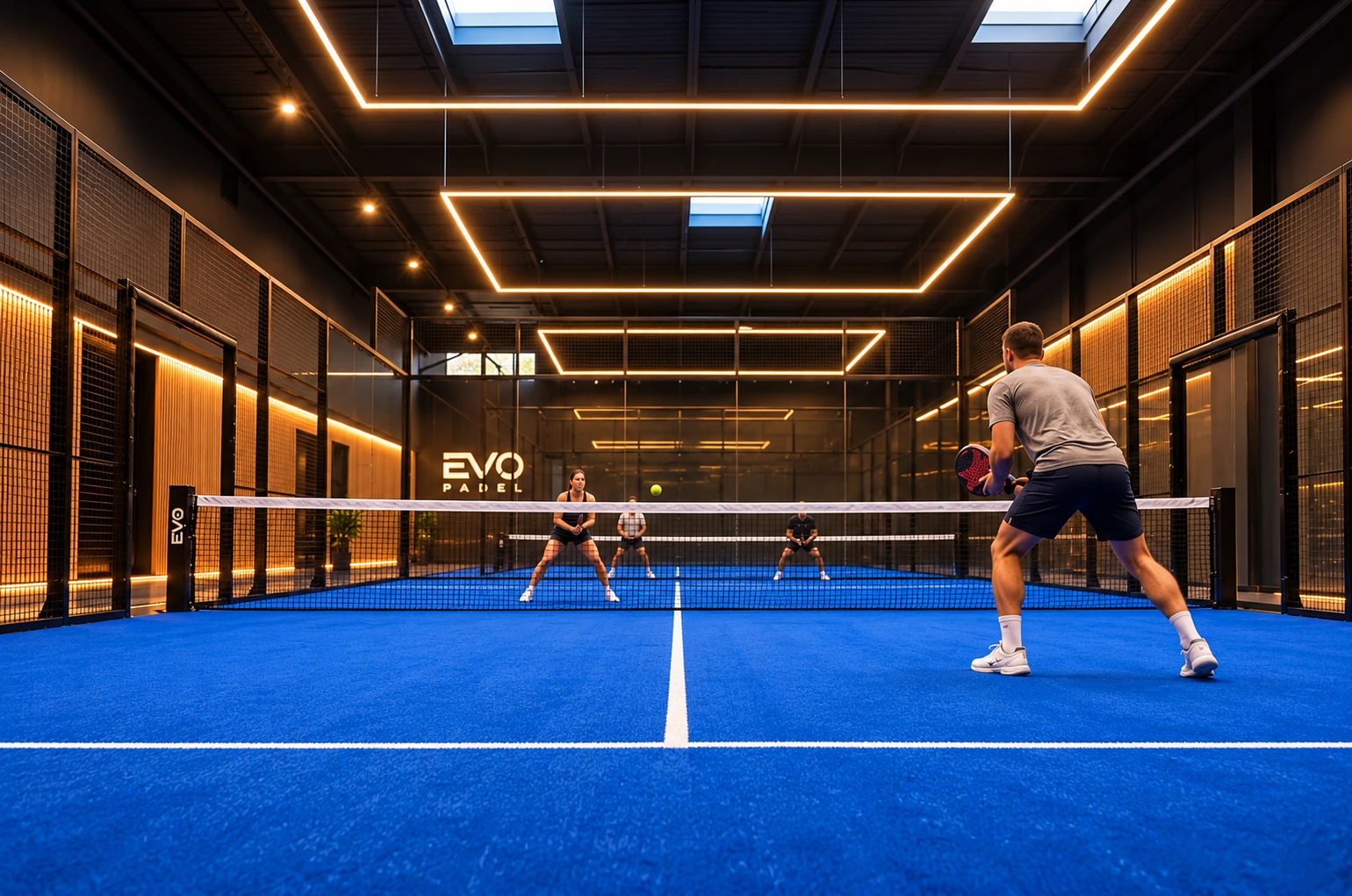
The short answer
Is indoor or outdoor padel better?
Indoor padel is generally better for predictable, all-weather playing conditions, while outdoor padel is better for players who prefer fresh air, daylight and open-air recreation. An enclosed, climate-controlled facility reduces wind, rain and temperature exposure; an outdoor court is more exposed to seasonal variation. Neither surface is inherently superior for every player.
01 / Market intelligence
Padel is scaling worldwide. Infrastructure decisions matter.
The International Padel Federation’s October 2026 report records an expanding global base of players and courts. These numbers describe all padel, they do not prove indoor courts are growing faster than outdoor courts.
Source: FIP World Padel Report 2026, October 14, 2026.
Graphic 01
Global court expansion
FIP reports +20.4% year-over-year growth in worldwide courts.
The previous-year value is a back-calculation from the published 2026 threshold and growth rate, not an independently published exact count. Bar lengths show an approximate relative comparison. Read FIP report
FIP also estimates €6.84 billion in global annual industry expenditure and €8.6 billion in contribution to GDP. These are different measures and should not be conflated with individual club revenue or profitability. Source
02 / The complete comparison
Indoor vs. outdoor padel, side by side.
| Factor | Fully enclosed indoor padel | Outdoor padel |
|---|---|---|
| Wind | Usually excluded from play | Can alter ball trajectory, especially lobs |
| Direct sun and glare | Controlled with appropriate lighting design | Depends on court orientation and time of day |
| Rain | Direct rainfall excluded | May interrupt or cancel bookings |
| Heat | Can be managed with adequately sized HVAC | Depends on weather and scheduling |
| Schedule reliability | Often greater protection from weather interruption | Weather and seasons can affect availability |
| Beginner learning | Predictable practice conditions | Good for learning adaptation to the elements |
| Upfront infrastructure | Building, HVAC, lighting and code compliance may add cost | Site work, drainage, court construction and lighting |
| Operating costs | Energy, climate systems, property maintenance | Outdoor upkeep, weathering, other site costs |
| Experience | Controlled, integrated and potentially all-weather | Open air, sunlight and outdoor atmosphere |
| Best fit | Severe climate, year-round training, predictable programming | Favorable conditions, outdoor lifestyle, suitable land economics |
Comparison is qualitative analysis, not the result of a national head-to-head performance study. Design, climate and club execution change the outcome.
Consistency & reliability
Enclosed courts reduce outside wind and sun exposure. For serious training and busy players coordinating four-person matches, predictable conditions can add significant convenience.
Open-air appeal
Outdoor padel blends social sport with fresh air and natural light, and can be an excellent experience in comfortable weather. It also teaches players to adapt to variable conditions.
03 / Las Vegas evidence
Why climate changes the indoor padel equation.
For Las Vegas, extreme summer heat, not rainfall alone, is a compelling reason to consider indoor padel. The National Weather Service and NOAA’s 1991–2020 climate normals quantify the local conditions.
Climate period: 1991–2020. National Weather Service Las Vegas · NOAA Las Vegas airport station normals (PDF).
Graphic 02 / NOAA 1991 to 2020
Las Vegas monthly average daily highs
Values are historical climate normals, not a 2026 temperature record or a calculation of unusable playing days. Chart built from NOAA station USW00023169. NOAA methodology
How this affects the player experience
Outdoor bookings may cluster in cooler periods during the hottest months. A properly air-conditioned indoor venue can offer more comfortable daytime slots, structured coaching sessions and events. But ventilation, HVAC sizing and actual indoor temperature matter: simply putting a roof over a court is not the same as climate control.
04 / Player experience
Does playing indoors make you a better padel player?
Not automatically. The strongest practical argument is that an enclosed indoor setting removes some environmental variables, making technical drills and repeated practice more consistent. There is not enough directly comparable evidence here to claim a universal improvement in skill-development speed.
Technique and repetition
Volleys, bandejas, lobs and overhead shots require precise timing. Reduced wind variation may help a coach isolate technique during practice. Outdoor players, however, develop the valuable skill of adapting those same shots to changing conditions.
Visibility and lighting
Outdoor glare can make overhead shots harder at certain times. Indoor lighting offers control, but poor fixture placement can still impair visibility. The International Padel Federation publishes the game’s official regulations and technical guidance.
Video, analytics and training
Stable indoor lighting can support video recording and tracking, provided cameras and software are properly configured. Indoor space alone does not guarantee accurate analytics; camera calibration, lighting uniformity and the selected technology matter.
What’s the best option for beginners?
A beginner may appreciate fewer variables indoors, but great coaching, clear instruction, community and a welcoming onboarding program are more important than the roof. Outdoor clinics can be equally valuable in favorable weather.
05 / The business case
Could indoor padel produce stronger court economics?
Potentially, but a claim that indoor clubs are more profitable than outdoor clubs would require comparative operating data. Indoor facilities often incur extra rent, HVAC, construction or retrofit expenses. Their potential offset is more weather-resilient bookings and a broader set of amenities.
Graphic 03 / Interactive scenario model
Monthly revenue per court
Change the assumptions to see the effect of paid court utilization. This is a hypothetical planning calculator, not industry benchmarking or EVO financial guidance.
Illustrative monthly gross booking revenue for one court; excludes taxes, refunds, memberships, energy, staffing, lease and construction costs.
Formula: hourly rate × available hours/day × operating days × utilization. There is no verified national indoor-versus-outdoor average utilization rate in this model.
Indoor cost drivers
Enclosure, utilities, heating and cooling, insulation, air handling, fire and building requirements, interior operations and property costs.
Outdoor cost drivers
Site availability, drainage, site preparation, weather exposure, lighting, surfaces, fencing, and climate-related maintenance.
A credible investment decision should compare total installed cost, energy load, available court-hours, actual booking demand, pricing, weather interruptions, and all non-court revenues on a location-specific basis.
06 / Real-world inspiration
Existing US clubs illustrate different approaches.
These are independent examples, not EVO locations or endorsements. Each one links to the club’s own page, so readers can explore the actual venue and understand the context.
Padel Haus: Williamsburg
Brooklyn, New York. Indoor club with hospitality amenities.
Reserve Padel: Miami
Miami, Florida. Outdoor courts with lounge and social setting.
07 / The EVO perspective
Indoor padel should be more than a roof over a court.
At EVO Padel, the vision for Las Vegas is an integrated indoor-club experience: seven doubles courts, one dedicated singles court, technology-enabled play, member programming, recovery amenities, community spaces and coworking.
For a desert city, the objective is straightforward: make great padel easier to fit into everyday life while creating opportunities to connect before and after the match. These are planned EVO features, not a claim that the venue has already opened.
EVO Padel / Las Vegas
Your court. Your community. Made to Evolve.
Discover a new indoor padel experience designed around the way you play, train, work and connect.
08 / Frequently asked questions
Indoor vs. outdoor padel FAQs
Is indoor padel better than outdoor padel?
Indoor padel is more protected from wind, direct sunlight and rainfall, and can provide climate control. Outdoor padel offers natural light and an open-air atmosphere. The best choice depends on your climate, schedule and personal preferences.
Is indoor padel easier to play?
It can be more predictable because wind and changing sun position are less of a factor. The core sport and standard court dimensions remain the same.
Is indoor padel faster?
Not universally. Temperature, humidity, altitude, ball pressure, playing surface and other factors affect the ball. A simple indoor-versus-outdoor label cannot predict game speed.
Can you play indoor padel all year?
Generally yes, subject to operating hours, maintenance, building availability and climate-control performance.
Is indoor padel more expensive?
Building and energy costs can be higher, but court pricing varies widely by market and club. Total economics must be evaluated by project.
Why choose indoor padel in Las Vegas?
Extreme summer heat makes temperature-controlled recreation attractive. NOAA normals indicate an average July high of about 104.5°F at Las Vegas airport.
Are indoor and outdoor padel courts the same size?
A regulation doubles padel court measures 20 by 10 meters. Clearance and technical facility requirements also need to be considered.
What is the difference between covered and climate-controlled padel?
Covered courts have overhead weather protection, but can still be open to wind or outdoor air. A fully enclosed and conditioned indoor venue can manage more of the environment.
Do professional players compete indoors and outdoors?
Yes. Both venue types host competitions; tournament-specific requirements and conditions determine the playing environment.
Transparency / Sources
Research sources & methodology
This article distinguishes source-backed facts, qualitative reasoning and a hypothetical revenue model. We have not asserted unsupported US indoor market share, national preference percentages or an indoor profitability premium.
- International Padel Federation: World Padel Report 2026 announcement
Players, global courts, 20.4% court growth, countries and economic estimates · October 14, 2026 - International Padel Federation: Full World Padel Report 2026
Industry methodology and full report entry point - National Weather Service: Las Vegas 1991–2020 Climate Normals
Historical temperature and rainfall context - NOAA NCEI: Las Vegas airport monthly normals, station USW00023169
Climate station PDF used for the monthly chart and temperature metrics - NOAA: U.S. Climate Normals definitions and data methodology
- Padel Haus: DUMBO Brooklyn
Indoor-club example - Padel Haus: Williamsburg
Indoor-club amenities - Modern Luxury: Reserve Padel Miami
Outdoor club example - Reserve Padel: SoLé Mia
Hybrid facility example
Source statistics should be revisited when new annual reports are published.