
How AI Is Changing Padel: Smart Courts, AI Coaching & the Future of the Game
Artificial intelligence in padel is moving beyond recording matches. Smart cameras can now turn rallies into clips, statistics and coaching feedback. But what can these systems actually measure, how do leading platforms compare, and which advances could change the sport between now and 2031?
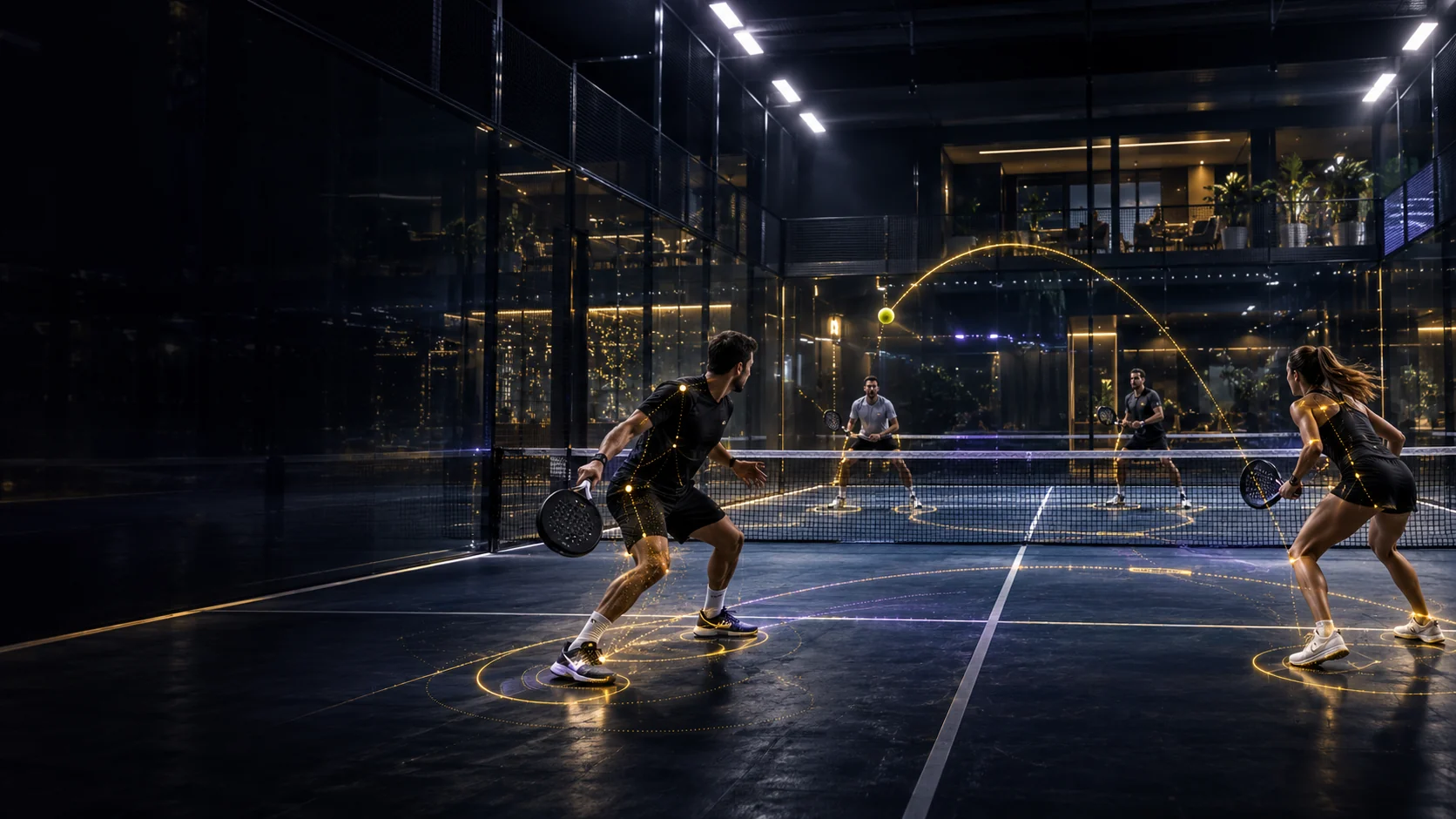
The Short Answer. AI in padel uses computer vision, machine learning and data analysis to turn match footage or booking data into practical information: shot locations, rally patterns, highlights, player ratings, training priorities and club decisions. Today, automated video highlights, selected match analytics and algorithmic matchmaking are commercially available. Fully autonomous coaching, reliable injury prediction and universally accurate AI officiating remain more uncertain. [6] [7] [9] [10] [11] [13]
1. Why AI in padel matters now
Padel has the right ingredients for useful sports technology: a compact, enclosed court, repeatable camera positions, regular doubles matches and a growing community of amateur players who want to improve. Computer vision can identify patterns that may be difficult to remember after a long rally; connected software can turn those patterns into feedback.
The addressable sports audience is expanding. In its October 2026 World Padel Report, the International Padel Federation (FIP) estimates more than 40 million active players worldwide, more than 91,200 courts, and approximately US$7.66 billion in annual padel-industry expenditure. This approximate USD figure converts the FIP original of €6.84 billion at the European Central Bank’s October 22, 2026 reference rate (EUR 1 = USD 1.1205). These figures describe the overall sport, not spending on AI products or an estimate of the AI market. [1] [2] [17]
For perspective, FIP’s 2025 report had identified more than 35 million players and 77,300 courts. The two reports provide useful annual snapshots of a fast-expanding sport; neither measures AI technology adoption. [15]
Source: International Padel Federation, World Padel Report 2026; industry spending is converted into USD from the FIP’s €6.84B at ECB’s Oct 22, 2026 reference rate. All metrics describe padel overall, not AI adoption. [1] [17]
The U.S. opportunity: many players, different levels of commitment
In the United States, USA Padel reports that the Sports & Fitness Industry Association (SFIA) counted 1,073,000 people who played padel in 2025. Of those, 835,000 played one to seven times and 238,000 played eight or more times. That means roughly 78% were occasional participants under this definition, while 22% played at least eight times. The study is a national participation estimate, not a count of club memberships. [3]
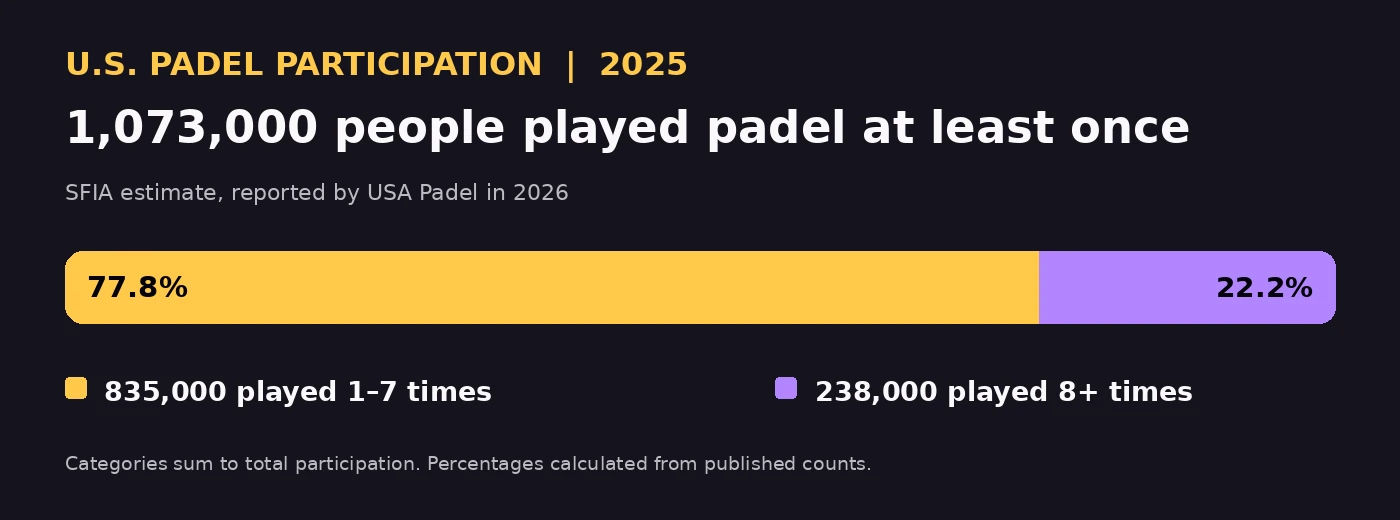
This matters because technology should serve different needs. A first-time player may value an effortless match replay and easy matchmaking. A committed competitor may want shot-location maps, rally analysis and measurable practice goals. The most successful AI tools will make the next session more valuable, not simply produce more data.
For more about the people entering the sport, read our related article: Who Plays Padel in America? U.S. Padel Demographics & Trends →.
2. How does AI technology actually work on a padel court?
A smart padel court typically combines cameras, software and a delivery experience. It is important to distinguish recording, computer vision, analytics and coaching, they are different layers, and not every product offers all four.
Figure 2. Conceptual AI-assisted improvement loop. Real capabilities differ by camera setup, vendor and software tier.
Step 1: Capture the match
Cameras record the court. Depending on the system, one wide-angle video camera may be enough for highlights, while richer spatial tracking may require additional views or specialized tracking cameras. Camera placement, lighting, glass reflections, frame rate and connectivity all affect the result. Wingfield AI Pro, for example, describes a modular system with video and tracking components. [7] [8]
Step 2: Detect players, the ball and shots
Computer-vision models attempt to locate the ball, track players and identify events such as a serve or smash. This is a real area of scientific development. The 2026 PadelTracker100 research dataset contains nearly 100,000 annotated video frames covering ball tracking, player position, body-pose landmarks and shot categories. But the dataset comes from only two professional matches filmed with a consistent broadcast-style camera angle, so it should not be mistaken for proof of universal accuracy at recreational clubs. [6]
Step 3: Turn observations into understandable feedback
Raw coordinates have little value unless they answer a useful question: Are we losing control at the net? Do we make more errors after deep lobs? Are we hitting too many short balls? Software can organize the footage and, where supported, provide shot maps, rally filters and performance summaries. Some systems also generate written coaching suggestions. [7] [9]
Step 4: Apply the insight, then measure again
A coach should connect each metric to a practical drill. For example, a player who repeatedly misses defensive lobs can practice depth and decision-making, then compare subsequent sessions. AI is most useful when it closes the loop between watching, understanding and training. It should supplement, rather than replace, qualified coaching and the athlete’s own experience.
3. Seven ways AI could change the player experience
1. Automated match highlights and shareable video
This is one of the most tangible applications today. Instead of reviewing a 90-minute match manually, players can browse extracted rallies and share short clips. Clutch and Wingfield advertise automated highlight and video features, though outputs and available packages differ. Highlight algorithms may favor dramatic rallies over the strategically important mistakes a coach wants to review. [7] [9]
2. AI-assisted match and shot analysis
Where the tracking works reliably, players can see shot types, winners, errors, rally length and placement patterns. This creates a more objective starting point for a conversation about technique and tactics. Yet all metrics should be checked against video, especially for difficult wall rebounds, overlapping players and ambiguous points. [6] [7] [8]
3. More personalized coaching
A generic lesson teaches fundamentals; an AI-assisted lesson can start with observed match behavior. The coach could compare video clips, choose two high-impact weaknesses and assign related drills. Future systems may make this workflow more conversational, but AI-generated advice still needs sport-specific judgment and validated measurements.
4. Better matchmaking and competitive balance
Player ratings can help clubs schedule more evenly matched games. Playtomic’s levels use an algorithm based on competitive match results, team ratings and a reliability measure. This is valuable software, but an algorithmic rating system is not automatically the same thing as generative AI or computer-vision tracking. [11]
5. Tactical analysis for doubles teams
Because padel is largely a doubles game, AI may help analyze how partners move together: which pair controls the net, how the team recovers after a lob, and whether one player repeatedly leaves a gap. Team-level insights can matter more than a headline number such as smash speed. These capabilities should be evaluated feature by feature rather than assumed from the term “AI camera.”
6. Smarter club operations
AI-enabled workflows may eventually suggest programming, predict high-demand periods or reduce administrative friction. For context, Playtomic already provides ordinary occupancy reporting by court, day, time and court type, without every such report necessarily being AI-generated. Clubs should measure whether added automation improves real occupancy or service quality before attributing business growth to AI. [12]
7. Movement analysis and responsible recovery support
Pose estimation could help visualize footwork, movement symmetry and training load. However, a video-based movement score is not a medical diagnosis or a demonstrated injury-prediction system. A 2023 systematic review of eight studies involving 2,022 participants found injuries were common, but the evidence was limited and heterogeneous. It did not validate AI injury forecasting. [13]
4. Traditional padel analysis vs. AI-assisted padel: what changes?
| Question | Traditional approach | AI-assisted approach | Important limitation |
|---|---|---|---|
| What happened in the match? | Memory and manual notes | Searchable recordings and tagged rallies | Missed or wrongly tagged events |
| Why did I lose points? | Coach observes patterns | Shot and error maps can support review | Data requires tactical interpretation |
| How do I improve? | General drills and coach feedback | Drills informed by recurring match errors | No guaranteed faster improvement |
| Who should I play? | Self-reported level and social groups | Match-result ratings and suggested levels | Ratings can be noisy for new players |
| How can a club improve occupancy? | Manual booking review | Occupancy reports and potentially predictive tools | Analytics alone does not create demand |
The choice is not human coaching versus AI coaching. Better results are more likely when coaches use reliable data to ask better questions, and when athletes are still encouraged to feel, adapt and experiment on court.
5. What the research says: reducing errors may matter more than flashy winners
An important finding from the scientific literature is that not every winning strategy produces exciting video. A 2023 systematic review of performance analysis in padel, covering 27 studies, summarizes findings in which 44.9% of point-ending actions were unforced errors, compared with 38.4% winning strokes and 16.7% forced errors. Those figures reflect the studies reviewed, not a universal split for every ability level or setting. [5]
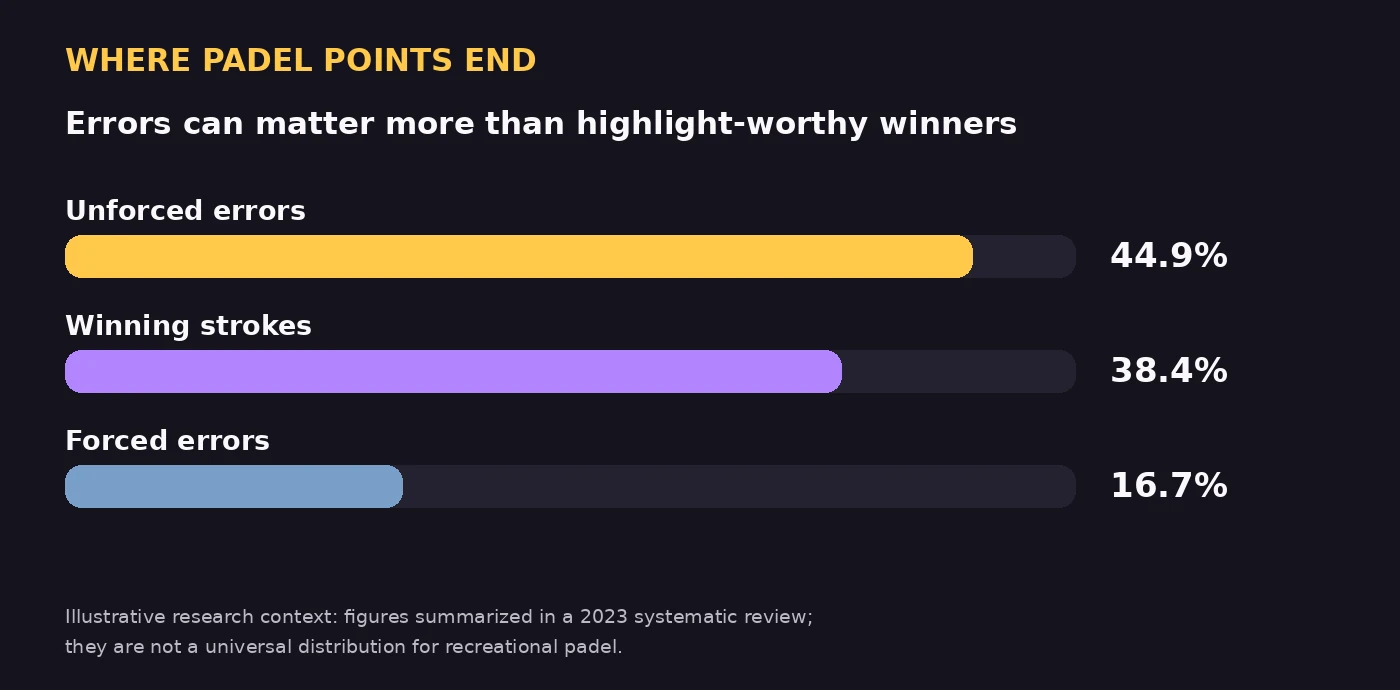
What does this imply for AI coaching? If a tool only celebrates winners, it risks missing the training opportunity. A more actionable dashboard could help a player review the type, location and context of repeated mistakes, then track whether the pattern changes after practice. Importantly, not every error is avoidable, and models may disagree about whether an error was forced.
Researchers are also building the foundations for better tracking. PadelTracker100 labels ball positions, player poses and shot events, supporting future models. Yet the gap between laboratory datasets and diverse club footage remains significant: lighting, camera angles, clothing, glass and amateur playing styles all introduce new conditions. [6]
6. Clutch vs. Wingfield vs. Padlab vs. Playtomic: which technology does what?
These products solve related but different problems. The table below summarizes publicly described capabilities as of October 2026, not the results of an independent head-to-head test. Product features, hardware bundles and integrations can change.
| Platform | Primary focus | Publicly described capabilities | Best research question before adopting |
|---|---|---|---|
| Clutch | Padel camera + player experience | Automated clips, shot/error stats, AI coaching summaries, dynamic player scores | How accurate are classifications on our courts and with our members? |
| Wingfield AI Pro | Video + training analytics | Highlights, tracked shot stats, placement maps, drills and replay tools | Which camera package enables the analytics versus video-only features? |
| Padlab | Real-time smart-court experience | Vendor describes player/ball tracking, instant replay, auto-scoring and live metrics | Can independent live tests confirm accuracy under normal club conditions? |
| Playtomic | Booking and player ecosystem | Reservations, algorithmic levels, open-match matchmaking and club reporting | What booking/data integrations are supported for our AI-camera vendor? |
What does an AI padel camera cost in U.S. dollars?
Clutch’s published U.S.-localized rate for 4–9 courts shows $159 per court per month with month-to-month billing, or $139 per court per month on an annual plan. For an eight-court club, that equals $1,272 per month on the monthly plan or $1,112 per month equivalent ($13,344 per year) under the annual plan. The annual figure is a monthly equivalent, not an indication that the annual plan can be paid monthly. These are the U.S.-listed rates, not converted euro prices. The vendor may also display EUR pricing based on storefront or location: confirm the actual invoicing currency, hardware, taxes and contract terms before buying. Clutch pricing. [16]
For the other platforms in this comparison, an installation-specific quotation is more reliable than an assumed average. Comparing systems should include camera hardware, installation, bandwidth, analytics tiers, storage, privacy management and access to video exports.
Two distinctions matter: Wingfield’s video-only products and AI Pro tracking do not provide identical analysis; and Playtomic’s match-result rating algorithm is not a substitute for video-based shot recognition. Padlab’s real-time product descriptions are vendor claims, so buyers should test rather than assume accuracy. [7] [8] [9] [10] [11] [12]
How should a player choose an AI padel system?
For a recreational player, the best system may simply be the one already installed at a nearby club that makes videos easy to access. For a coach, useful choices depend on the quality of shot classification, searchable film, export options and drill workflows. For club owners, reliability, privacy, service, integrations and cost matter as much as marketing features. No single platform is objectively “best” without specifying the use case and testing the deployment.
7. Can AI work equally well on indoor and outdoor padel courts?
AI systems can work indoors and outdoors, but performance depends on the individual installation. Indoor environments offer more consistent control over lighting and weather. Outdoor courts introduce changes in sunlight, glare, wind-driven camera movement and heat. Indoor glass reflections, challenging LED flicker and low-light corners can also create problems. These are engineering considerations, not evidence that one court type automatically produces better AI results.
The ideal deployment test should sample morning, afternoon and evening sessions; beginner and advanced players; singles and doubles where relevant; and volleys, lobs, smashes and glass rebounds. Compare the system’s labels against manually reviewed video rather than relying only on marketing demos.
For the wider playing-experience comparison, see Indoor vs. Outdoor Padel: Playing Conditions, Comfort and Performance →.
8. The future of AI in padel, 2026–2031: a realistic outlook
The next five years may bring substantial change, but the timeline below is EVO Padel’s editorial assessment, not an independently validated forecast. Capability adoption will depend on computer-vision accuracy, hardware costs, privacy expectations, integrations and the willingness of players and clubs to pay.
Video first
Automated highlights, selected shot statistics, algorithmic match ratings, coach review and club reporting are already offered by different vendors.
Useful connected coaching
Better multi-session progress reports, personalized drills, easier integration with bookings and more natural-language summaries, if data quality is dependable.
More context-aware courts
Richer partner-movement analysis, broader smart-court experiences and advanced assistance for officiating or physical preparation; evidence and human oversight remain essential.
What is unlikely to disappear: the human coach and the social game
Padel succeeds because of movement, tactics, partners and community. AI can make feedback easier to access, but it cannot automatically explain motivation, interpersonal chemistry, confidence under pressure or the enjoyment of a close match. The better future is augmented padel, not automated padel.
9. What should a smart padel club actually measure?
An AI system should be evaluated as a member experience, a coaching tool and an operating service, not just a camera purchase. A sensible pilot should answer the following questions before promising business results:
- Accuracy: How often does it correctly tag serves, lobs, winners, errors and ball positions compared with a human-reviewed sample?
- Consistency: Does accuracy hold for night sessions, different skill levels, glasses, doubles formations and reflections?
- Speed: How soon after a match do members receive usable clips and statistics?
- Player adoption: What share of consenting players actually open and revisit their highlights?
- Coaching usefulness: Can coaches identify and act on recurring patterns, or are the metrics mostly decorative?
- Data rights: Who owns raw video, performance data and derived profiles, and can members delete or export them?
- Integrations: Does the system connect to bookings and memberships without duplicate accounts or unsupported API promises?
- Economics: What is the full cost after hardware, subscription, installation, maintenance, storage and staff time?
Do not infer return on investment from views or shares alone. A credible business case should examine incremental member engagement, repeat visits, coaching bookings and operating cost, while allowing for other causes of change.
Privacy, consent and the limits of body analysis
If club cameras process identifiable video, biometric features or minors’ activity, operators should communicate recording policies plainly and offer meaningful controls. Access to raw footage, retention periods, training-data reuse, sharing permissions and vendor security should be reviewed before installation. The NIST AI Risk Management Framework offers a structured approach to evaluating trustworthiness and managing AI risk. [14]
Computer vision can identify body landmarks, but current public research does not establish that a club camera can reliably diagnose injuries, prevent all injuries or replace clinicians. Health or recovery recommendations should remain appropriately qualified and involve trained professionals. [6] [13]
10. EVO Padel’s perspective: technology should make every session more meaningful
At EVO Padel, we see AI as one potential part of a larger modern padel experience: a place where people can play, train, recover and connect. In designing the Las Vegas club experience, the key question is not how many dashboards fit on a screen. It is whether a player leaves knowing what to practice next, enjoys sharing a memorable rally, and wants to return with their doubles partner.
That vision requires the right fundamentals: thoughtfully planned court infrastructure, strong coaching, excellent lighting, dependable connectivity, transparent data practices and a culture that welcomes beginners as well as serious competitors. Specific AI integrations remain subject to vendor evaluation and implementation; nothing in this article should be read as an announcement of a live feature.
Our view: The biggest opportunity for AI in padel is to connect one session to the next, from match footage, to a meaningful insight, to a practice plan, to an even better experience on court.
Play. Train. Recover. Connect.
Discover the EVO Padel vision
Explore a next-generation padel community taking shape in Las Vegas.
Frequently asked questions about AI in padel
What is AI in padel?
AI in padel refers to software that uses machine learning, computer vision or other data-driven models to analyze match footage and related player information. Depending on the product, it can create highlights, track shots, estimate court positions or generate coaching suggestions. Simple booking reports and ratings may be algorithmic without necessarily using modern AI.
Can AI analyze a padel match automatically?
Yes, several commercial systems advertise automatic match recording, highlights and selected statistics. The quality and depth of analysis vary by provider, camera installation and software package. Players should check specific outputs against video, especially for wall rebounds and ambiguous shots. [7] [9]
Can AI tell me why I lost a padel match?
AI can identify patterns worth examining, for example, where errors cluster, how long rallies last or how often a team reaches the net, if those measurements are supported by the system. It cannot always determine the true cause of a loss. Coaching interpretation remains important.
Does AI replace a padel coach?
No. It can assist a coach with footage, tagging and progress data, but coaches provide tactical judgment, technique corrections, communication and context. There is no strong evidence that any current general-purpose AI camera reliably replaces expert padel coaching.
What are the best AI padel cameras?
There is no objectively best camera for every club. Clutch emphasizes the padel-specific player experience and coaching insights; Wingfield AI Pro offers training analytics and video workflows; Padlab markets an integrated real-time smart court. Verify actual features, installation requirements, privacy and accuracy during a live trial. [7] [9] [10]
Is Playtomic an AI padel camera?
No. Playtomic is primarily a booking, player and club-management ecosystem. Its competitive rating system uses an algorithm that considers match results and level reliability. It is distinct from camera-based shot tracking. [11] [12]
Does AI padel work outdoors?
Some vendors support outdoor use, but performance depends on hardware suitability, camera placement, light and local weather conditions. The right approach is to test the complete system in the actual environment rather than assume indoor or outdoor is always better. [7] [9]
Can AI prevent padel injuries?
Not reliably as a proven general medical claim. Body-pose tracking may support movement review, but published evidence of padel injuries does not establish that AI video systems accurately predict or prevent them. Seek qualified medical advice for pain or injury. [6] [13]
What is the future of AI in padel by 2030?
Likely directions include more searchable match video, connected coaching plans, better player profiles and improved interoperability between cameras and booking platforms. More ambitious applications such as autonomous officiating and injury forecasting depend on evidence that is not yet sufficient for broad guarantees.
Continue reading on EVO Padel Insights
Sources and research methodology
This article was researched against published federation data, peer-reviewed sports-science research and official vendor product documentation, reviewed October 22, 2026. Vendor claims are attributed to their vendors; hypothetical future capabilities are explicitly presented as possibilities. Statistics for worldwide padel participation, U.S. participation and point outcomes use different populations and must not be combined into a single growth estimate. The article is not a clinical or independent product-testing study.
- FIP World Padel Report 2026: official highlightsInternational Padel Federation · 2026
- FIP World Padel Report 2026: methodology and report hubInternational Padel Federation · 2026
- Padel Surpasses One Million Players in the United StatesUSA Padel / SFIA participation data · 2026
- USA Padel 2025 Annual ReportUSA Padel · 2026
- Performance Analysis in Padel: A Systematic ReviewJournal of Human Kinetics (open access) · 2023
- PadelTracker100: Dataset for Intelligent Player and Ball TrackingData in Brief / DOI · 2026
- Wingfield AI Pro: product featuresWingfield · Accessed Oct 2026
- Wingfield: Staff Wiki and feature requirementsWingfield Help Center · 2026
- Clutch: AI Camera for PadelClutch · Accessed Oct 2026
- Padlab: AI Smart Padel CourtsPadlab · Accessed Oct 2026
- The Playtomic Levels and AlgorithmPlaytomic Help Center · 2026
- Playtomic Manager: Occupancy ReportPlaytomic Help Center · 2026
- Incidence, Prevalence and Nature of Injuries in Padel: A Systematic ReviewBMJ Open Sport & Exercise Medicine · 2023
- AI Risk Management FrameworkU.S. National Institute of Standards and Technology · 2023 onward
- FIP World Padel Report 2025: previous baselineInternational Padel Federation · 2025
- Clutch camera pricing: U.S. pricing tableClutch (U.S.-localized vendor listing) · Accessed Oct 2026; verify checkout currency
- ECB reference rate, October 22, 2026: EUR 1 = USD 1.1205European Central Bank · Oct 22, 2026